
The Hidden Cost of Keeping AI Insights and Execution in Separate Tools
October 10, 2026
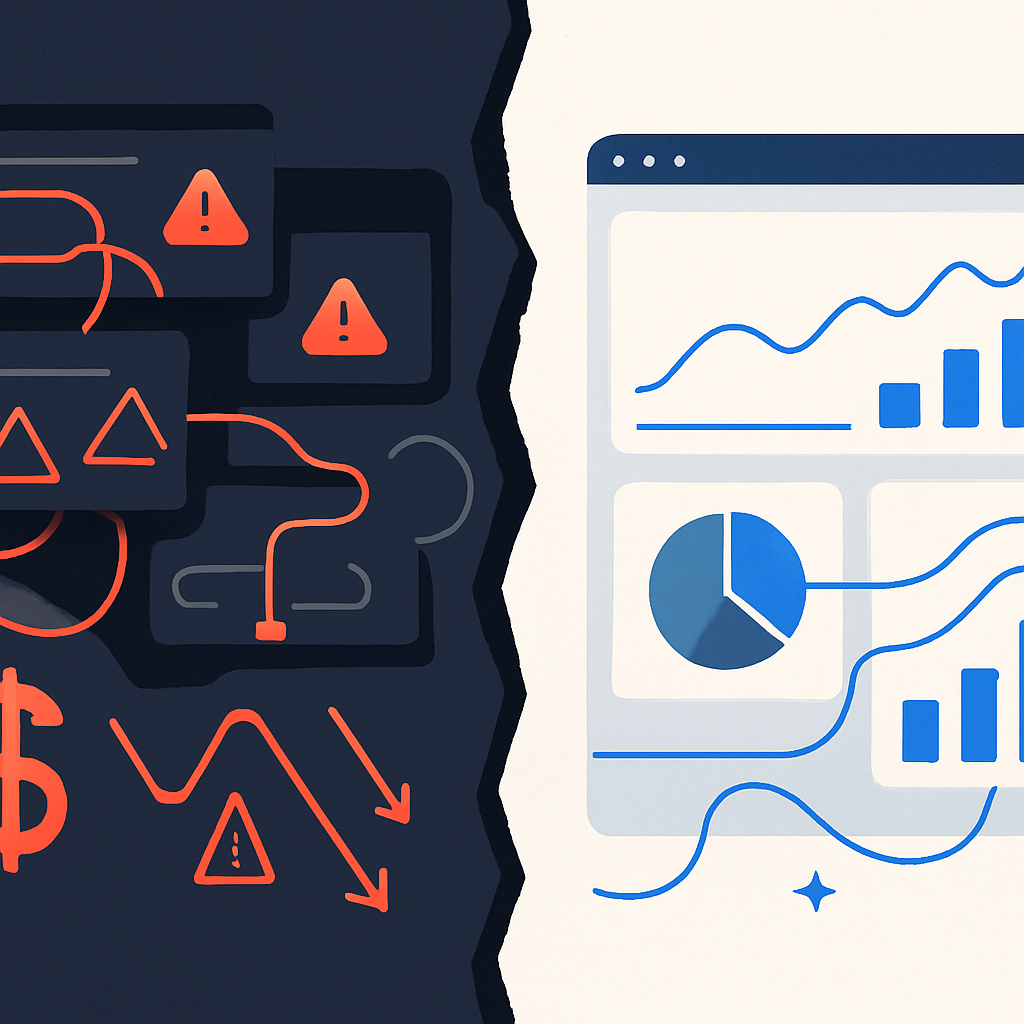 Disconnected AI tools create hidden costs through manual handoffs, context loss, and duplicated data entry that compound across teams every day. This post makes the financial and operational case for consolidating insight and execution into a unified environment.
When AI Insight and AI Execution Live in Different Places, Someone Pays for the Gap
The cost of disconnected AI tools rarely shows up as a line item on a budget. It appears instead as the fifteen minutes an analyst spends re-entering a recommendation from one platform into a task manager, or the context that evaporates when a signal from a monitoring dashboard never makes it to the person who can act on it. Individually these moments look trivial. Across a team of twenty people, running every day, they compound into a meaningful drag on output and decision quality.
CFOs consolidating their SaaS stacks are starting to notice. The conversation has shifted from "which tools do we need" to "how many handoffs can we eliminate." Disconnected AI is one of the most underexamined places where that question leads.
Why the Cost of Disconnected AI Tools Is Hard to See
Most organizations measure tool costs by license fees. They rarely measure the labor cost of moving outputs from one tool to another, and almost never measure what is lost in translation during that move.
Consider a common setup. An AI monitoring platform flags an anomaly. A team member reads the alert, interprets it, writes a summary, pastes that summary into a project management tool, assigns it to someone, and that person then opens a separate AI assistant to figure out what to do next. Each step in that chain introduces:
- Time spent on transcription rather than decision-making
- Interpretation gaps, where the person summarizing may not capture every relevant detail
- Latency between detection and action
- A broken audit trail, since the original signal and the eventual response live in different systems
None of this is visible in a software invoice. It only becomes visible when someone calculates how many hours per week a team spends bridging tools that were never designed to talk to each other.
Context Loss Is the Steepest Hidden Tax
AI systems produce outputs that are most useful when they carry context: the conditions that triggered a recommendation, the data behind a prediction, the history of prior decisions in the same situation. When those outputs are exported to another tool, most of that context gets stripped away. What arrives at the destination is a conclusion without its reasoning.
This forces the person receiving the output to either trust it blindly or go back to the source system to reconstruct what they need. Both outcomes are expensive. Blind trust leads to worse decisions. Reconstruction takes time that was supposed to be saved by using AI in the first place.
A unified environment keeps reasoning and action in the same place. The person acting on a recommendation can see what generated it without switching tabs or re-querying a separate system.
Duplicated Data Entry Multiplies the Risk, Not Just the Work
Every time a human copies data from one system to another, two things happen. The work takes longer than it should. And the chance of introducing an error goes up.
Manual transcription between AI tools is particularly error-prone because the outputs are often nuanced: percentage likelihoods, ranked options, conditional recommendations. These are easy to misread, truncate, or misplace in a receiving system that was not built to accept them cleanly.
Over time, organizations end up with divergent records. The monitoring tool shows one version of an event. The execution tool shows a slightly different version, shaped by whatever got typed in during the handoff. When something goes wrong and teams need to trace back through decisions, they find a trail that does not fully cohere.
The Audit and Accountability Gap
This divergence creates a specific problem for compliance and governance. Regulated industries and any organization that takes AI governance seriously need to be able to show what information was available at the point of a decision, and what action followed from it. Disconnected tools make that reconstruction difficult or impossible.
A single environment where insight and execution share the same data layer closes that gap. Every decision sits next to the signal that prompted it.
What SaaS Consolidation Actually Requires
CFO-driven consolidation conversations often focus on reducing vendor count. That is a reasonable starting point, but vendor count is a proxy for the real goal: reducing the operational friction that comes from systems that do not share context.
Cutting from twelve tools to eight accomplishes little if the eight tools still require manual handoffs between insight and action. The measure that matters is how many times a human has to act as a bridge between an AI output and an AI-powered workflow.
The organizations that get the most from consolidation are those that ask which tools cover the full arc from signal to decision to execution, and then rationalize around those rather than around price or brand preference.
A Practical Way to Map the Gap
Before making consolidation decisions, it helps to trace a few representative workflows end to end. For each one, document:
- Where the AI-generated insight originates
- How many systems that insight passes through before someone acts on it
- How many of those transitions are manual
- What context is present at the point of action compared to what was present at the point of detection
Most teams that do this exercise are surprised by the number of manual steps they have normalized. The insight-to-action distance is usually longer than anyone realized, and the context that survives the journey is thinner than expected.
What a Unified Suite Changes
A platform designed so that insight and execution share a single environment eliminates the handoff problem structurally. The recommendation and the workflow that acts on it exist in the same place, with the same data underneath them.
This is the design principle behind how Accelimate AI fits into a broader suite that includes Intellimate AI for intelligence and Vigilimate AI for monitoring. When monitoring surfaces an issue, the execution layer can respond without requiring a human to manually carry information between systems. The context that Vigilimate AI captures is available to Accelimate AI directly. The team member involved is coordinating action, not transcribing data.
That distinction matters for productivity. It also matters for accuracy. And in environments where the speed of response to a signal has business consequences, it can matter for outcomes in ways that are straightforward to measure.
The Calculation That Convinces Finance
Finance teams respond to numbers. The argument for a unified AI suite becomes concrete when it is expressed as labor recovered rather than friction reduced.
If a team of fifteen spends an average of thirty minutes per day on manual handoffs between AI tools, that is 7.5 person-hours daily. Across a year, that is roughly 1,875 hours. At a blended loaded labor cost of $75 per hour, the number exceeds $140,000 annually, before accounting for the cost of errors introduced during those handoffs or the value of decisions that were slower than they needed to be.
These are estimates. Every organization should run the calculation against their own numbers. But the structure of the argument is sound, and most teams that run it find the result large enough to justify a serious look at consolidation around tools that eliminate the gap.
The starting point is mapping your current insight-to-action workflows and counting the manual steps. Book a conversation with the Accelimate AI team to walk through what that analysis looks like in practice.
Tags